Welcome to the Mathematical World!
Xu Guangqi
Scholar-Official and Introducer of Western Science to China
Xu Guangqi (1562–1633) was a Chinese polymath of the Ming Dynasty who made significant contributions to mathematics, astronomy, and agriculture. A high-ranking official and collaborator with Jesuit missionaries, he played a central role in introducing Western science and mathematics into China. His most famous collaboration was with Matteo Ricci, with whom he translated parts of Euclid’s Elements into Chinese.
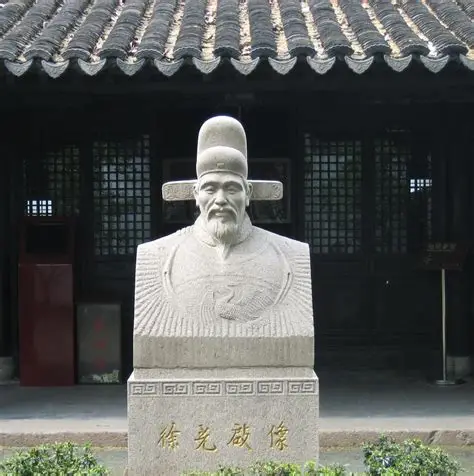
Xu was deeply interested in geometry, algebra, and trigonometry, recognizing their practical applications in fields such as surveying and calendrical reform. Through the translation of Elements, he helped introduce deductive reasoning and rigorous proof-based geometry to Chinese scholars. Equations such as the Pythagorean theorem, \ were presented in a logical framework that emphasized axioms and proofs rather than numerical calculation alone. This marked a profound shift in Chinese mathematics.
In addition to mathematics, Xu worked extensively on astronomy, helping reform the Chinese calendar by incorporating trigonometric methods. He also promoted agricultural science, advocating improved irrigation, crop rotation, and the introduction of new crops such as sweet potatoes. His efforts reflected a vision of science as a tool for social betterment.
Xu Guangqi’s legacy is that of a cultural bridge: he blended Confucian scholarship with Western science, laying the groundwork for modern Chinese scientific thought. He is celebrated today as one of the “Three Pillars of Chinese Catholicism” and as a reformer who helped reshape the intellectual landscape of late Ming China.

All rights reserved by the Mathematical Unity
Contact: +8801400044645
Email: mathematicalhorse1453@gmail.com
Our Discord Server: Mathematical Unity [Ulus Riyadiyat]